The nearly five-hour 2026 CFDA Fashion Awards honored Rachel Scott, Ralph Lauren, Ana Khouri and other designers across 12 categories.
The 2026 CFDA Fashion Awards were as much a test of stamina as a celebration of American fashion: a nearly five-hour program, 12 awards and a guest list spanning designers, performers and industry executives. That scale is part of the story. The night put established names and newer designers on the same stage, while the awards themselves offered a snapshot of who the CFDA chose to recognize.
The ceremony, presented by Amazon Fashion, took place Monday at the American Museum of Natural History. Guests moved between a red carpet, cocktails, dinner and the awards, with a chicken pot pie course continuing the CFDA’s long-running dinner tradition. Above the tables hung the museum’s 94-foot-long, 21,000-pound blue whale. Keke Palmer hosted; the evening wrapped up close to 11 p.m.
The program was packed: videos, presenters and acceptance speeches filled the hours between the 12 awards. CFDA chairman Thom Browne opened by describing a “monumental year” for American fashion. He pointed to designers and creators whose “spectacular shows” during New York Fashion Week, he said, were reaching audiences across the country and around the world. The praise was broad; the awards gave it names.
The evening’s guests included Pamela Anderson, Vera Wang, Lea Michele, Christian Siriano, Kate Barton, Jonathan Simkhai, Narciso Rodriguez, Steven Lagos, Lana Todorovich, Todd Kahn, Reed Krakoff, Henry Zankov, Isaac Mizrahi, Kobi Halperin, Deirdre Quinn, Maria Cornejo, Danielle Kallmeyer, Emily Smith, Rose Byrne, Becky G, Kenneth Cole, Allison Janney, Gracie Abrams, June Ambrose, Sergio Hudson, Carolyn Murphy, Jason Wu, Julia Fox, Megan Thee Stallion, Travis Scott and Stacey Bendet.
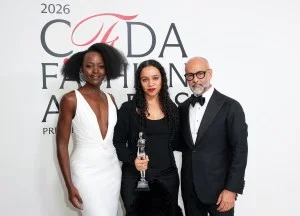
Lupita Nyong’o, Rachel Scott and Francisco Costa. John Nacion/WWD
Designers and industry figures take the awards
Celebrity News coverage also tracked the red carpet, including the night’s best-dressed guests. Onstage, Nyong’o and Francisco Costa presented the American Womenswear Designer of the Year award to Rachel Scott of Diotima, her second win in the category. Matt Damon and Tremaine Emory presented American Menswear Designer of the Year to Ralph Lauren, who won for the third time.
Naomi Osaka and Joseph Altuzarra handed the American Accessory Designer of the Year award to Ana Khouri. Cole Escola and Gabriela Hearst presented the Google Shopping American Emerging Designer of the Year award to Colleen Allen, a Brooklyn-based womenswear designer who founded her namesake label.
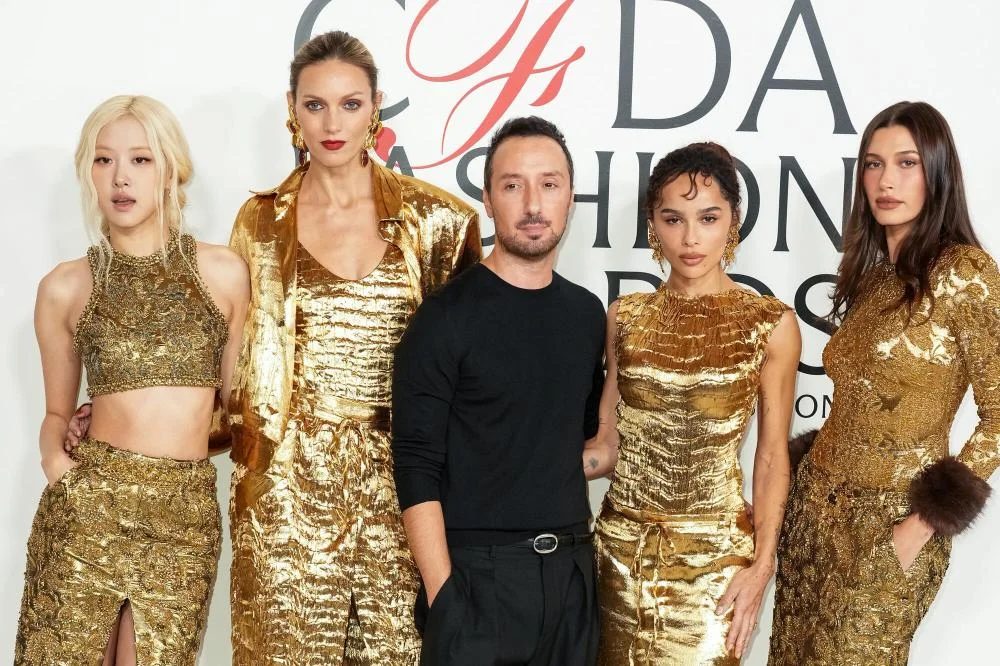
Anna Wintour presented the Positive Change Award to Tory Burch. Peter Marino was named Fashion Icon, with Cornelia Guest presenting the award. Hailey Bieber, Rose and Zoë Kravitz presented International Designer of the Year to Anthony Vaccarello, who had stepped down as YSL creative director in October after 10 years.
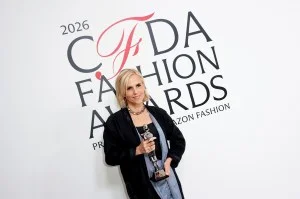
Tory Burch. John Nacion/WWD
Demi Moore presented Gap Inc. with the Innovation Award, presented by Amazon Fashion. Laufey gave the Media Award in honor of Eugenia Sheppard to Eva Chen, Meta and Instagram’s vice president of fashion. Michael Kors presented the Founder’s Award in honor of Eleanor Lambert to Linda Fargo, Bergdorf Goodman’s senior vice president and fashion and store presentation director.
Other coverage from the night includes CFDA Fashion Awards red-carpet photos and an account of the dinner and party. For a different fashion event, Fashion Scoops reports that the Ralph Lauren holiday experience is expanding to seven cities.
Scholarships, legacy and a measure of purpose
The evening’s speeches made a case for fashion’s institutional memory—and for who gets the resources to shape what comes next. That tension came through in remarks from W Magazine editor in chief Sara Moonves, who marked 30 years of the CFDA Scholarship Fund. “Over the past three decades, CFDA scholars have gone on to shape the industry, emerging as influential creative voices and leaders,” she said. This year, the fund awarded a record $1.5 million directly to design students across the country. In 2027, the CFDA x WYouth Scholarship, presented by Nuuly, is set to add funding for two students. The amount is significant, but the longer-term measure will be what those students can do with it. Tory Burch described a similar bet on purpose. When she set out to build a global lifestyle brand that could support a foundation for women, investors warned her against putting “business and purpose” in the same sentence. She ignored them: the company began in 2004, and the foundation followed in 2009. Burch said its community now includes millions of women around the country sharing advice and experience, and that the foundation is on track to reach $1 billion in revenue by 2030. “One of the most important things I’ve learned is that you don’t have to have every resource to begin making the change that you want to see,” she said.Recognition across generations
Ralph Lauren’s American Menswear Designer of the Year award arrived as his namesake brand marked its 60th anniversary. Damon and Emory presented the honor; Lauren, seated with his wife Ricky and members of his team, had previously won it in 1996 and 2007. He won the American Womenswear Designer of the Year award last year, having first taken that prize in 1995. The repeat recognition says as much about his staying power as it does about the industry’s willingness to revisit its icons. ThreeAsFour’s Adi Gil, Angela Donhauser and Gabriel Asfour presented the Isabel Toledo Board of Directors’ Tribute to designer and artist Susan Cianciolo. Charles Star Matadin presented the Geoffrey Beene Lifetime Achievement Award to his parents, photographers Inez van Lamsweerde and Vinoodh Matadin, whose work has appeared in fashion magazines and advertising campaigns. That family connection shaped Vinoodh Matadin’s acceptance speech. He told his son that watching him “become the man he is today” was the greatest achievement of his and Inez’s lives. He also thanked the CFDA for honoring their work together since 1986, including the 35 years they have called New York home. Van Lamsweerde recalled arriving from Amsterdam in 1992 as artists in residence and cold-calling art directors, magazines and record labels without getting a chance to show their work. Agent Bryan Bantry’s advice, she said, was to return to Europe, become stars there, and then the American industry would want them.
Purpose, visibility and the people behind the work
Wintour’s introduction of Burch’s Positive Change Award offered a lighter detail before landing on a firmer portrait. Vogue global editorial director and Condé Nast chief content officer Anna Wintour said family and friends recalled Burch wrapping beautiful Christmas boxes for her brothers and filling them with rocks. Their more serious description, Wintour said, was of someone “strong, persistent and a fighter by nature.” She briefly lost her place among her pages at the end of the introduction; one guest was overheard quipping, “Well, somebody’s going to lose their job.” Meta’s Eva Chen used her Media Award speech to explain why the spotlight still feels strange. In high school, she volunteered for the school musical but stayed backstage, building and painting sets before operating the spotlight. Now, she said, it was surreal to share the stage with “generational brands like Tory, Linda [Fargo], Inez and Vinoodh.” Her 15-year-old self, she added, would never have imagined it.

Retail as culture
Michael Kors presented Bergdorf Goodman’s Linda Fargo with the Founder’s Award, praising her as a “fashion oracle and style clairvoyant” whose visual storytelling puts clothes at the center. He said her eye for fashion, paired with a Midwesterner’s practical approach to luxury, had transformed American retail. Fargo connected the honor to the award’s history: the first Eleanor Lambert Founders’ Award, in 2001, went to Bergdorf Goodman fashion director Dawn Mello, whose instincts helped put many designers—including people in the room that night—on the American map. Mello hired Fargo when she was unknown. Fargo recalled mailing her a portfolio of “hopes and dreams” and receiving, in return, a career she described as an “infinitely rewarding world.” She was wearing Michael Kors Collection.

Recognition, and the people behind the work
Peter Marino joked that his head-to-toe leather look usually gets attention in clubs after midnight. The real point, he said, was the CFDA’s recognition of his career connecting fashion, architecture and fine art. Over several decades, Marino has designed more than 420 stores and commissioned more than 350 works by leading artists. He singled out the work of Yves Saint Laurent, Giorgio Armani, Valentino, Carla Fendi, Calvin Klein, Donna Karan, Marc Jacobs, Virgil Abloh at Louis Vuitton and Karl Lagerfeld at Chanel. He also described persuading clients to budget for fine art as one of the most consequential parts of designing a store.

Colleen Allen, recipient of the Google Shopping American Emerging Designer of the Year Award, spoke about the support she’d found in the New York fashion community and dedicated the honor to her parents, who encouraged her ambitions from the start. It’s a personal note, but it also points to how much emerging designers depend on networks of support to build a career.

Anthony Vaccarello accepted the International Designer of the Year Award by thanking his team, Anna Wintour, Donatella Versace and his supporters in the U.S. His remarks after that were less about the clothes than the conditions that make creative work possible: connection, instinct, commitment and the courage to keep going when others don’t see the vision. Fashion, he argued, should provoke feeling, even discomfort; it doesn’t always need to explain itself. His reflection on a decade in the industry landed on a direct conclusion: success depends on the people who stand beside you while you create.
That idea carried into the final award. Lupita Nyong’o and Fernando Garcia presented Womenswear Designer of the Year to Rachel Scott, who said she hadn’t prepared a speech. She called herself lucky to collaborate with inspiring women, then pointed to the rarity of someone like her occupying that stage. Her closing thought was pointed: independent and marginalized voices are still systematically silenced, and there is work to do starting the next morning. The awards ended on a reminder that recognition matters most when it widens who gets heard.
Discussion
Sign in to join the discussion.